Website tips
Emma Lawes
When people know your name, not your company’s
Roger Atkins’s business was called Electric Vehicles Outlook. Nobody searched for that. What to do when people know your name, not your company’s.

4 min read

.svg)


Website tips
Emma Lawes
Roger Atkins’s business was called Electric Vehicles Outlook. Nobody searched for that. What to do when people know your name, not your company’s.
4 min read
Roger Atkins has spent more than forty years in the electric vehicle industry. He speaks at international events, hosts podcasts and has built a genuinely global audience.
His business was called Electric Vehicles Outlook.
Nobody searched for that.
They searched for Roger Atkins. They followed Roger Atkins on LinkedIn. When someone recommended him to a colleague, they said “you should talk to Roger”… not “you should look at Electric Vehicles Outlook”.
His website was built around the name that meant less.
It usually starts sensibly. You register a company name because you need one. It sounds professional, or it describes what you do, or it was simply the one that was available.
Then you spend five years building a reputation… and the reputation attaches to you, not to the name on the paperwork.
By the time you notice, your website, your email signature and your LinkedIn company page are all pointing at the wrong thing.
What do referrals actually say? When someone introduces you, do they use your name or the company’s? Look back at the last few enquiries that came in. The words people use to describe you are the words that should be on your homepage.
Which one has the following? If your personal LinkedIn has ten times the followers of your company page, that is your answer.
What do people call you in meetings? If nobody has ever said the company name out loud, it is not doing any work.
It doesn’t mean renaming the business. Roger’s company is still Electric Vehicles Outlook Ltd… that is a Companies House matter and it has very little to do with how people find him.
What changes is which name leads.
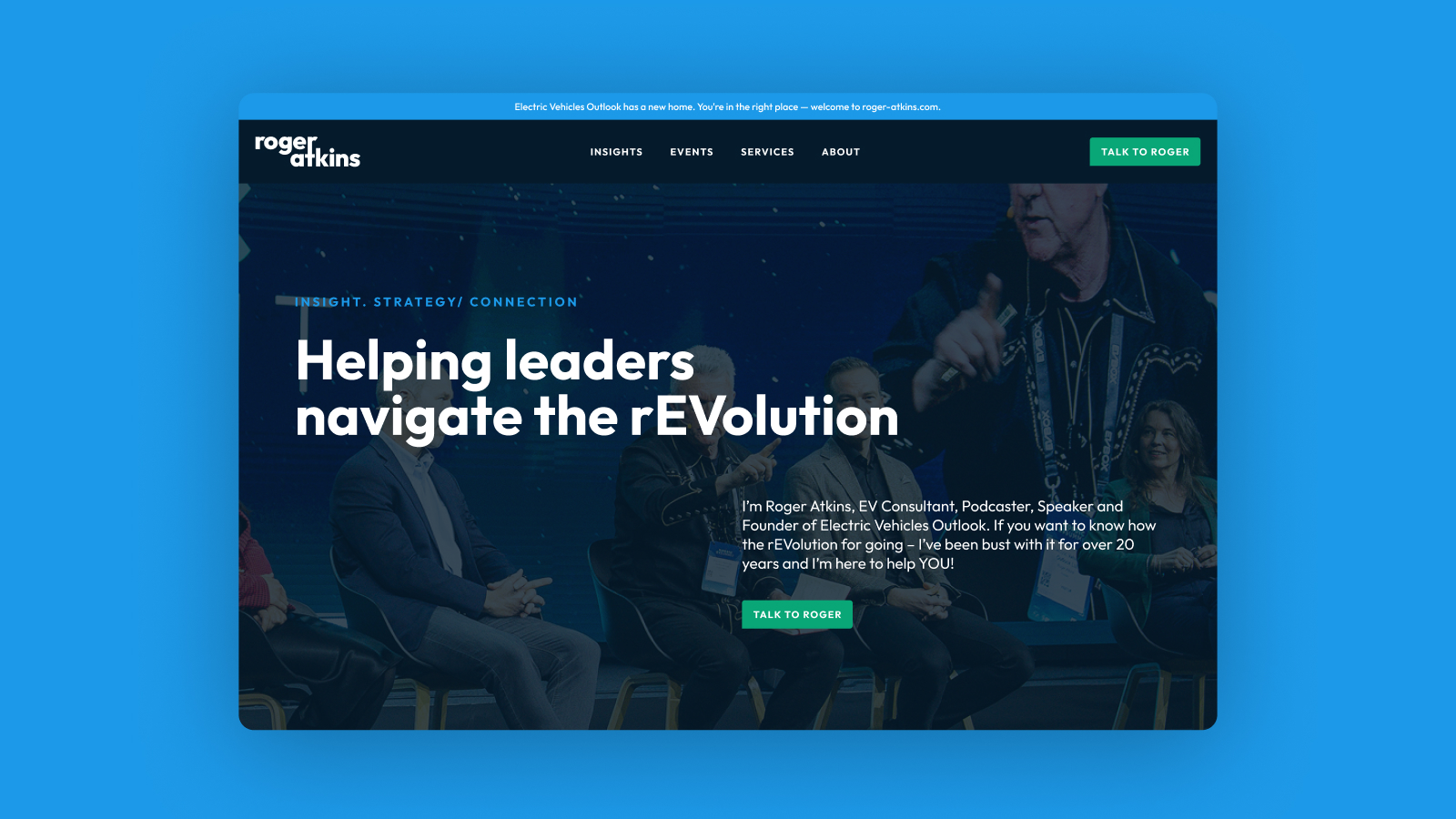
The website moved to roger-atkins.com and was rebuilt around him rather than around a company.
The homepage introduces the person before the services. The About page stopped being a career history and became a story about his expertise. The Insights and Events sections were restructured so his content is easier to find and easier for him to publish himself.
None of that is complicated. It just requires deciding, first, whose name people already trust.
Plenty of businesses are genuinely bigger than their founder. And some founders would much rather not be the front of the business at all. Both are completely reasonable.
The question is simply whether the name on your website is the one people already use.
Open your website on your phone and read the first sentence as though you had never met yourself.
Does it tell someone who you are? Or does it introduce a company name they have never heard of, when they arrived looking for you?
If it is the second one, that is a fixable problem… and usually a much smaller job than a full rebuild.
The full story of Roger’s project, including what changed and what it saved him, is in the Roger Atkins case study. You can see the rest of my recent work here, or read about what to do when you have outgrown Wix.